The Constellation Myth: Stars in a Pattern Are Not Neighbours
Constellation stars are not necessarily neighbours. Learn how distance and perspective shape familiar patterns, and choose a simple way to see their depth.
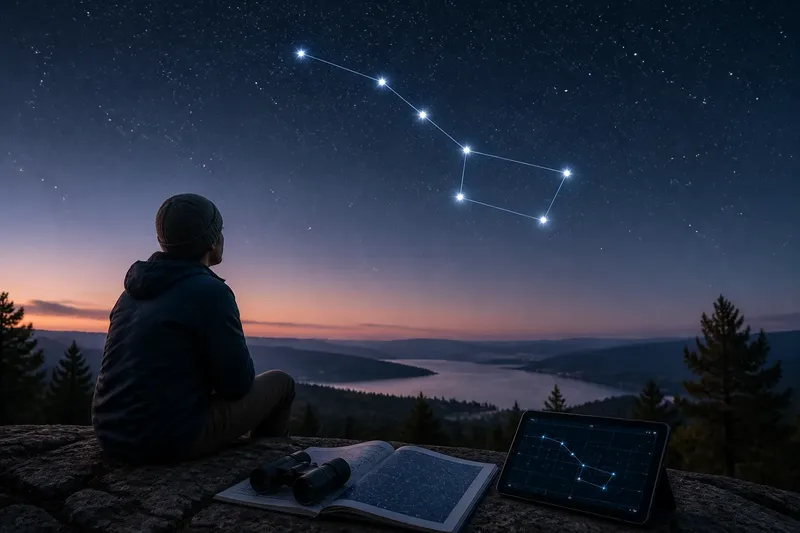
On a clear evening, the Big Dipper looks like a tidy scoop cut from the sky. Constellation stars can seem close enough to belong to one celestial family, but the pattern is a view from Earth, not a map of nearby suns. Their apparent grouping comes chiefly from perspective: stars at very different distances happen to line up in our direction.
The sky as a viewpoint
Our eyes give us a two-dimensional scene. They report where a star appears against the darkness, but ordinary naked-eye viewing does not reveal how far away it is. A pair of points can look side by side while one sits much farther into space than the other.
Think of looking through a window at a lamppost and a distant hill. They may seem aligned from your chair, though nobody would place the lamppost on the hillside. Shift your position and their apparent alignment changes. The stars are not moving into a constellation together; Earth’s location gives us a particular line of sight.
That line of sight is the central idea behind the constellation myth. The outline is real as a pattern seen from here. It is not, by itself, evidence that its stars are physically close, formed as a group, or arranged in a flat shape. Some stars can be related in other ways, but the familiar drawing alone cannot establish that.
Patterns and distances
Constellations are named regions of the sky, with familiar star patterns serving as guides within them. The Plough, often called the Big Dipper, is a prominent pattern in Ursa Major. Its stars make a useful shape for finding your bearings, yet the shape does not tell you their three-dimensional arrangement.
To understand depth, astronomers use measurements such as parallax: the apparent shift of a nearby star against more distant background stars as Earth moves around the Sun. That shift can help estimate distance. A star’s brightness and colour can contribute other clues, but appearance alone is not a reliable distance scale.
Different distances also mean the stars do not all send us light that began its journey at the same time. A more distant star’s light takes longer to reach Earth than light from a nearer one. So even a single glance at a constellation combines views of stars at different distances and from different points in their histories.
It can help to separate three ideas that often get bundled together:
- Apparent alignment: stars occupy similar directions in our sky.
- Physical proximity: stars are close to one another in space, something the pattern does not show.
- Shared origin or motion: stars may have a common history or move in related ways, which requires evidence beyond a familiar outline.
A constellation can therefore be an excellent observing aid and a poor three-dimensional diagram. Those are not contradictory roles. A street map helps you recognise a junction without showing every building at its true scale; a sky pattern helps you recognise a region without laying out its stars at their real distances.
Three ways to see depth?
How does a sky map help?
A printed star chart or a planisphere shows directions and relative positions across the sky. It suits a beginner who wants to locate a pattern and learn its neighbours on the celestial sphere, but it cannot communicate actual distance unless it adds separate distance information.
What can binoculars reveal?
Binoculars can bring fainter stars into view and make a crowded patch easier to examine. They suit someone curious about the richness behind a familiar outline, though added stars still appear as points in a field of view rather than as a model of their depth.
Can a three-dimensional model clarify the pattern?
A model or interactive star viewer can place selected stars at different distances, turning a flat outline into a view that can be rotated. It suits a learner who wants to grasp perspective directly, provided the display makes clear that the chosen stars and their positions are a simplified representation.
Which approach should you choose?
Choose a chart to find constellations, binoculars to inspect the surrounding star field, or a three-dimensional viewer to explore how the pattern changes with viewpoint. If your main question is “Are these stars neighbours?”, a depth-aware model is the most direct starting point; use a chart afterwards to connect that idea to the sky overhead.
A simple perspective exercise
Imagine you have a printed star chart and a phone or tablet with a three-dimensional star viewer. Pick the Plough on the chart, then locate the same stars in the viewer and rotate the view away from Earth’s familiar line of sight. The expected observable result is that the recognisable scoop stretches or changes shape as some stars appear farther forward or back than others.
This is a learning exercise, not a measurement. It shows why a pattern can be recognisable from one viewpoint without being a compact object in space. If the viewer offers a distance scale, read its labels and representation notes rather than treating the screen’s spacing as a literal scale model.
You can also make a modest observation with no equipment: sketch a constellation’s outline, then compare it with a different drawing that connects the same stars another way. The stars have not changed; the chosen lines have. That small distinction makes clear that the constellation figure is a human way of organising the view, not a boundary physically drawn in space.
What the pattern can tell you
A constellation remains useful even when its stars are unrelated neighbours. It gives observers a shared reference for describing where something appears, helps locate other stars and sky objects, and makes a large field easier to remember. Its usefulness comes from the stable arrangement seen from Earth, not from a claim about the stars’ private relationships.
That distinction also helps when comparing star maps and software. Some maps draw lines between selected stars; others mark only the official constellation region. The connecting lines are conventions for recognition, and different illustrations may choose different figures. Neither style turns a sky pattern into a three-dimensional arrangement.
For a first observing session, learn the outline as a set of directions: which stars form its corners, where it sits relative to a nearby bright star, and how its position changes during the evening. Then treat distance as a separate question. This keeps a useful navigation aid from quietly becoming a mistaken picture of space.
Looking beyond the outline
Constellation names and star patterns preserve ways people have organised and remembered the sky. Their stories can be meaningful without being literal descriptions of stellar geography. The scientific question is narrower: what do observations tell us about each star’s position, distance and motion?
For that, consult a reliable star catalogue or an astronomy app that lists individual stars and explains its distance information. A constellation name is a good search starting point, but the individual star’s catalogue entry is what can lead to a more precise account. Check what the display means by distance, since a visual layout may be illustrative rather than to scale.
Next time the Big Dipper seems to hang together like a single object, enjoy the outline and imagine changing your seat in space. The pattern would shift because the stars occupy different depths. Constellations help us find our way across the sky; remembering perspective lets us see the space behind the drawing.