When Galaxies Began to Be Counted
When galaxies began to be counted, better telescopes and sharper reasoning turned faint smudges into distant star systems beyond the Milky Way.
On a clear night, a faint blur in a telescope can look like a defect on the lens. For astronomers asking when galaxies began to be counted as separate worlds beyond the Milky Way, that smudge posed a sharper question: was it a cloud within our own star system, or an enormous collection of stars far outside it?
The answer did not arrive with one decisive glimpse. It emerged as telescope optics improved, observations became more systematic, and astronomers changed what they thought the blurred patches might be. To follow that process, start with the object itself, then watch how each new kind of evidence altered the interpretation.
Begin with the blurred patches
Before the word “galaxy” settled into its present meaning, observers catalogued fuzzy objects as nebulae, a broad term for cloudy-looking patches in the sky. Some were clouds of gas inside the Milky Way. Others were star clusters. A few, it would become clear, were separate galaxies, each containing immense numbers of stars.
From the ground, a nebula could be stubbornly indistinct. A telescope gathered more light than the unaided eye, but an object’s appearance depended on the instrument, the observer and the conditions. A small telescope might show a round haze; a larger instrument could reveal a spiral shape. Seeing structure did not, by itself, settle the object’s distance.
That distinction matters. A spiral pattern could indicate an organised object, but it could not alone tell astronomers whether the object sat within the Milky Way or beyond it. The first step in the story, then, is to separate what a telescope showed from what an observer inferred.
Make the telescope sharper
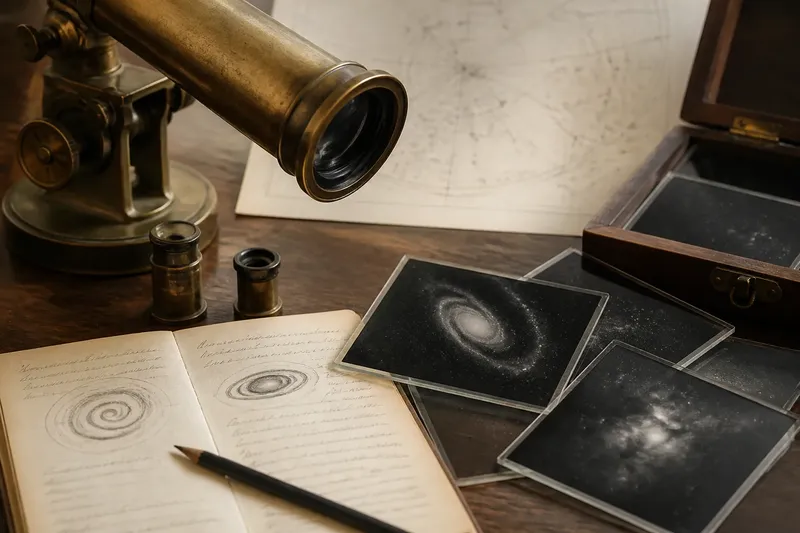
Early telescopes gathered light and enlarged the view, but their lenses and mirrors had limits. Better optical design brought clearer images; larger apertures collected more light from faint objects. Improved instruments could expose shapes and details that earlier observers had missed, while careful recording let astronomers compare what they saw.
Imagine an astronomer studying a dim oval patch through a modest telescope, then examining it again through a larger instrument with better optics. The patch now resolves into a spiral form with a bright centre and curved arms. The observable result is a more detailed image, not an automatic answer about distance: the astronomer has learned what the object looks like, but must still work out where it belongs.
Photography extended this process. A photographic plate could collect light during a long exposure, preserving faint features that were difficult to inspect by eye. Plates also gave observers a lasting record to compare, rather than requiring each detail to be held in memory. Yet a clear photograph remained a picture of the light arriving at Earth; interpreting the object still required other clues.
Separate shape from distance
As images improved, astronomers debated whether spiral nebulae were relatively nearby objects within the Milky Way or vast systems beyond it. The Milky Way was understood as a large stellar system, but its full extent and the location of its boundary were uncertain. Without a reliable distance, a spiral patch could be assigned very different meanings.
The issue resembled judging a distant building from its windows alone: a sharp outline tells you its shape, but not how far away it stands. Astronomers needed a way to estimate distance that did not depend simply on the object’s apparent size or brightness. A small-looking object might be genuinely small, or simply very far away.
This is where the study of variable stars became important. Some stars change brightness in a regular pattern, and the timing of that change can help astronomers infer how bright the star is intrinsically. Comparing that inferred brightness with how faint it appears from Earth gives a distance estimate. The method was not a magic answer: it depended on identifying the star and interpreting its behaviour correctly. But it supplied a new kind of evidence to weigh against the nebula’s appearance.
Read the evidence together
By the time astronomers could pick out individual stars in some spiral nebulae, they had more than a suggestive shape to consider. A variable star within one of these objects offered a way to estimate its distance. If that estimate placed the object far beyond the Milky Way’s bounds, the spiral could no longer be treated as a nearby cloud within our stellar home.
The shift was conceptual as much as technical. A fuzzy patch had first been a classification problem: what kind of nebula is this? It became a question about scale: is this object part of the Milky Way, or a separate stellar system? Once the second answer gained support, “galaxy” became the more fitting description for such objects, and the universe was no longer understood as ending at the edge of our own.
Counting galaxies therefore meant more than making a list of visible smudges. It meant deciding which smudges were independent systems, distinguishing them from gas clouds and star clusters, and recognising that faintness could signal great distance rather than a small or simple object.
Why did galaxies look like nebulae?
What did “nebula” mean?
It was a descriptive label for a cloudy-looking object, not a firm statement about what the object contained. Some nebulae were within the Milky Way; some of the spiral nebulae were distant galaxies.
Could a spiral shape prove an object was a galaxy?
No. A spiral form revealed structure, but it did not establish distance. Astronomers needed evidence that could show whether the object lay within the Milky Way or far outside it.
How did a variable star help?
Its changing brightness followed a pattern that could help estimate its intrinsic brightness. Comparing that with the light received on Earth gave astronomers a way to estimate distance.
Why were older observations uncertain?
Telescopes provided less detail, and astronomers had fewer independent clues for estimating distance. A blurred appearance left several explanations open, so different observers could interpret a similar patch differently.
Turn faintness into a count
Once galaxies were recognised as separate systems, counting them became a deeper challenge. A telescope does not reveal every galaxy equally: nearby, bright objects are easier to see, while more distant and fainter ones can disappear into the background. An image also records only the region of sky aimed at, and the result depends on how much light the instrument can collect.
A count therefore needs a clear boundary. Astronomers must specify what the instrument can detect and which patches qualify as galaxies rather than foreground stars, gas or image noise. Better observations can add objects to a catalogue, but they can also revise earlier classifications. The total is not simply the number of dots on a plate; it reflects the method used to identify and include them.
Modern instruments continue the same basic work with much greater reach. They gather light across different parts of the spectrum, sharpen images, and compare observations to distinguish distant galaxies from other sources. The old question—what is this blur?—has not vanished. Instead, astronomers can ask it with more detailed evidence and a clearer understanding of what a galaxy is.
What counting changed
Recognising other galaxies altered the scale of the cosmos. The Milky Way became one stellar system among many, not the whole of creation. That change did not come from a single telescope becoming powerful enough to settle everything. It came from instruments revealing new detail and from astronomers learning how to interpret that detail without confusing appearance for distance.
When galaxies began to be counted, the crucial advance was not merely seeing fainter smudges. It was learning which observations could turn a smudge into a separate world: shape to suggest structure, variable stars to estimate distance, and careful classification to distinguish one kind of object from another. The next time a fuzzy patch appears in an image, ask two questions: what can the instrument actually show, and what evidence tells us how far away it is? Those questions still give the universe its bearings.